
The Once and Future Dad
I review of Dad Brain by Darby Saxbe.

I previously published a conversation with Darby Saxbe about her new and exciting book, Dad Brain: The New Science of Fatherhood and How It Shapes Men’s Lives. Surveying the landscape of the relevant science and politics, we found many areas of agreement but have differing perspectives on how we should go about promoting more men into marriage and fatherhood. Below, I provide some additional sociopolitical context to our fatherhood conversation, cover some of the main claims made by the book and then provide some of my own criticism of specific claims. I also have a related but distinct review of the book at Goodreads.
The proverbial argument about fatherhood made by social conservatives is that fatherlessness is a harbinger of social deterioration. There are corollaries to this claim about the importance of traditional gender roles, including the importance of chastity and a division of labor in the home that endorses a “man for the field and woman for the hearth” vision. Around the millennium and afterward, empirical versions of this argument were reformulated by right-of-center wonks and scholars like George Gilder, Christina Hoff Sommers, James Q. Wilson, Harvey Mansfield, Charles Murray, and many others. Today, we are seeing left-of-center academics and wonks warming to the need to promote and support fatherhood and male socialization. One of the indicators of this shift is the recent publication of Dad Brain: The New Science of Fatherhood and How It Shapes Men’s Lives by Darby Saxbe and the attention it has received from journalists like Derek Thompson, Matthew Yglesias, and Jerusalem Demsas.
Pro-fatherhood, or ***gasp*** pro-patriarchy, arguments have trended toward a bloodless and technocratic tone, retreating from moral suasion. This has created a permission structure for those left-of-center to climb aboard, contributing significantly to the empirical case for fatherhood, but to many Americans, this rhetorical shift may seem to be coming at a perplexing time.
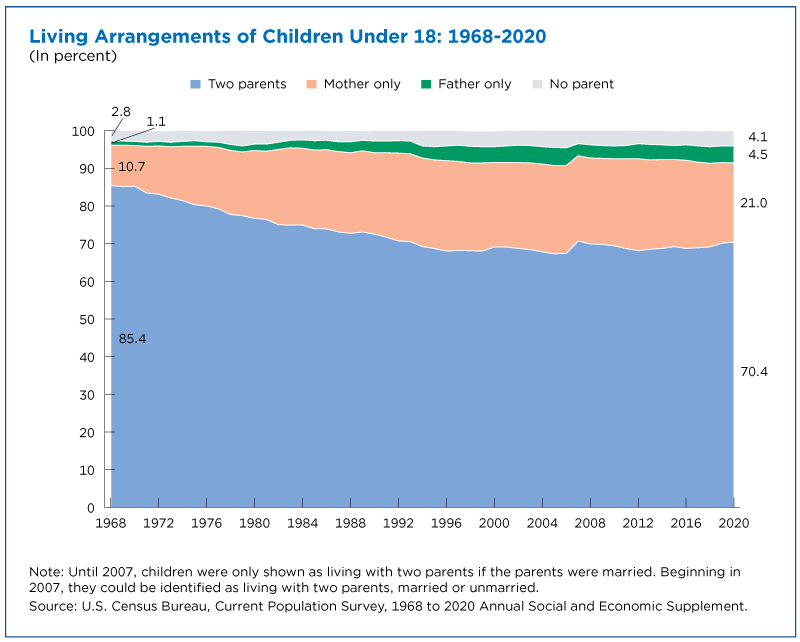
Although double the rate of five decades ago, the percentage of U.S. children living in single-mother households has stabilized over the last decade-and-a-half or so. Furthermore, data from the American Time Use Survey shows that contemporary fathers are spending unprecedented amounts of time with their children.1 On top of this, the American Time Use Survey data shows that the modern household division of labor is roughly 50:50! A total feminist victory! So why the concern?
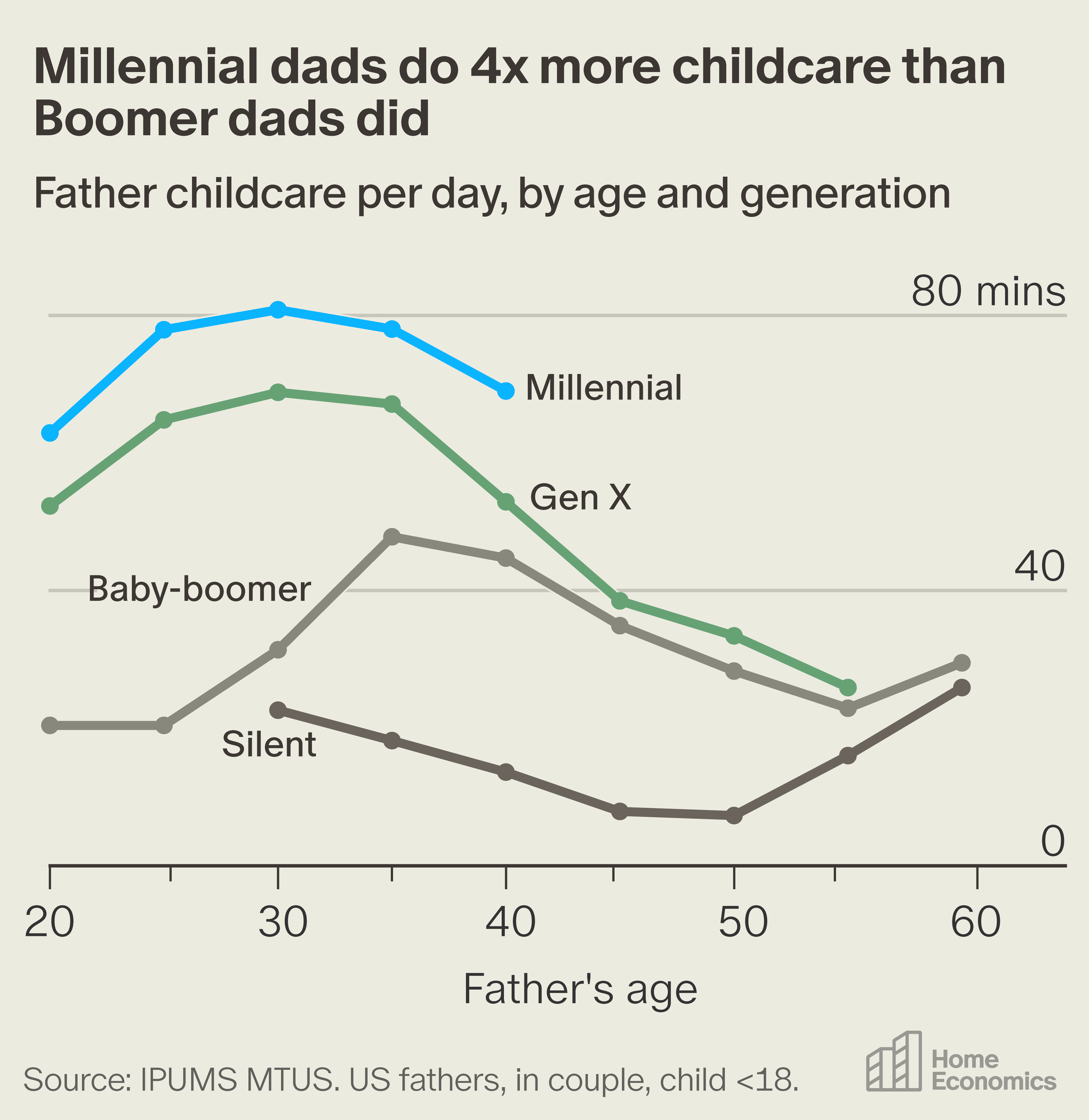
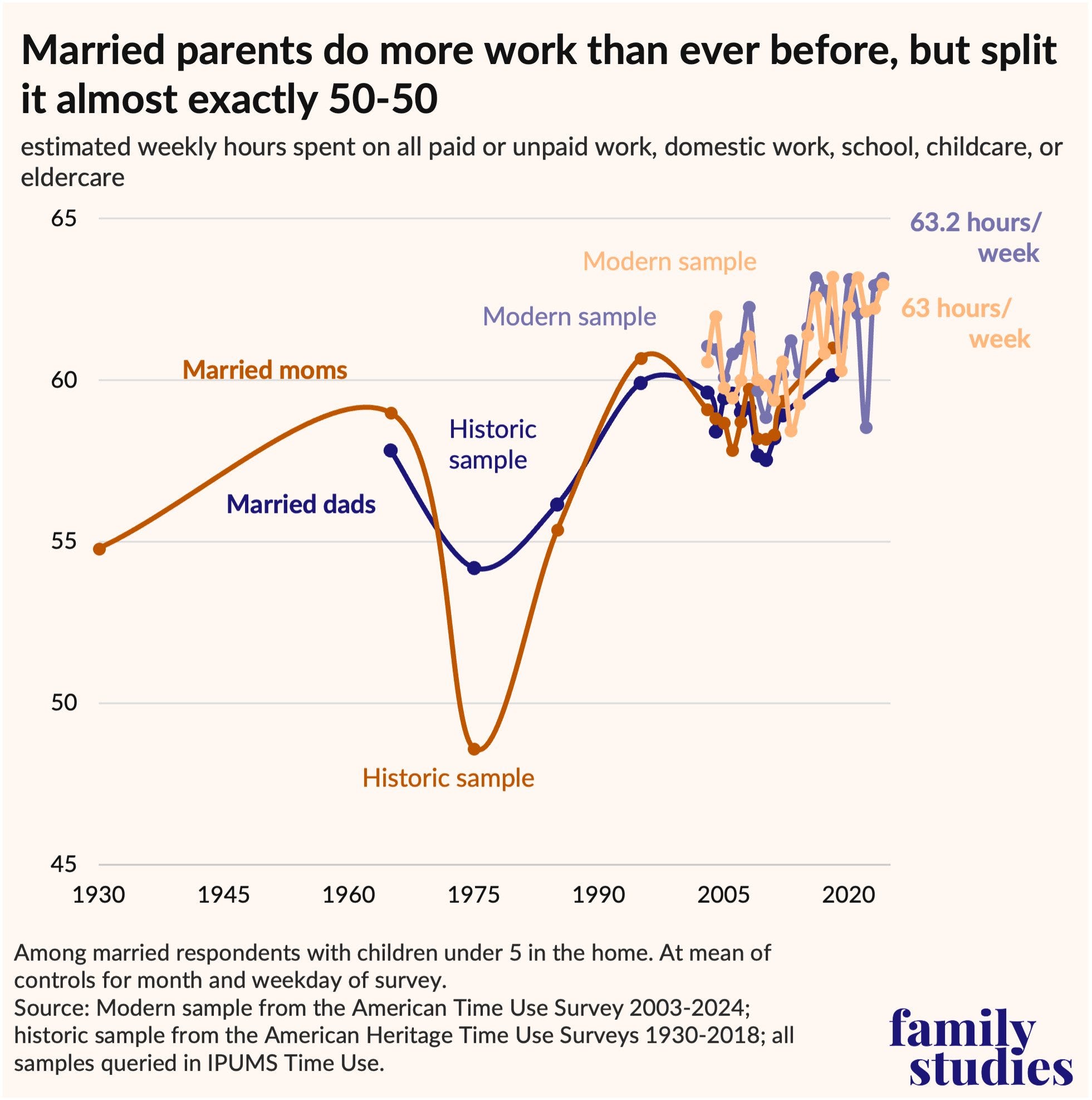
One could argue that the concern is related to the type of rhetoric that’s purportedly popular with today’s young men and boys. There’s been an endless amount of handwringing about and admonishment of various fringe and usually internet-related phenomena among young men, including the supposed popularity of provocative new media personalities from the so-called Manosphere, who unabashedly champion misogynistic or chauvinistic talking points while souring on the project of traditional fatherhood themselves. However, I think technocrats have started to care about fatherhood because there is mounting evidence that social dysfunction between young men and women combined with economic hurdles (e.g. high real estate prices) is a threat to posterity. They’re doing what they usually do: following the data.
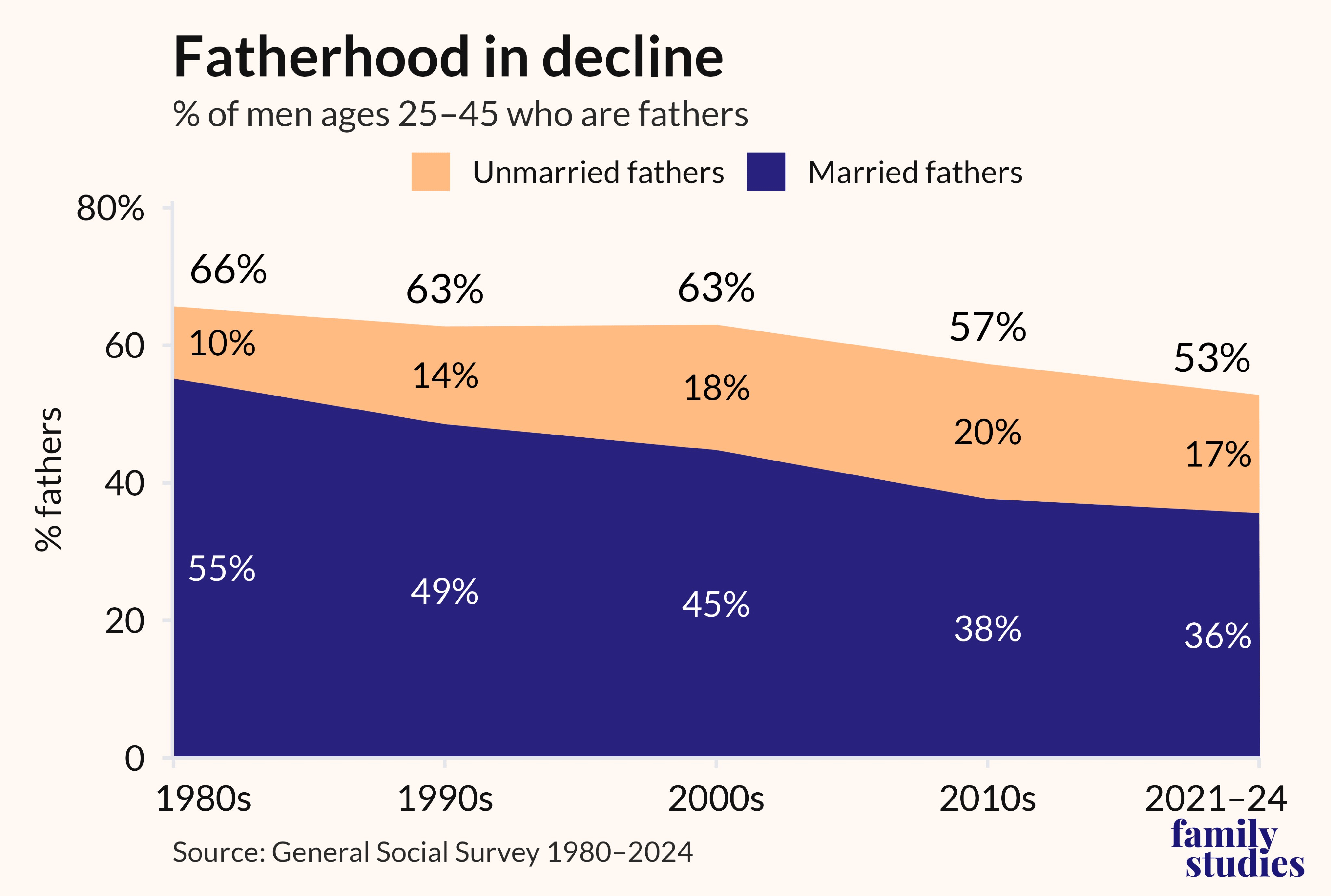
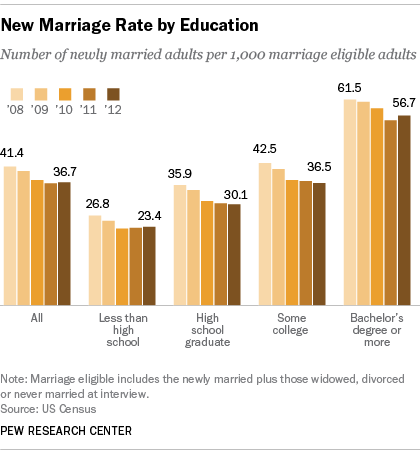
The data show that fatherhood is in secular decline, increasingly more difficult to access despite no real evidence of a change in preferences.2 The generalized generation-over-generation decline in family formation (i.e. marriage and parenthood), is relatively more concentrated among those without college degrees. Women have obtained bachelor’s degrees at nearly twice the rate of men for awhile now, and there is a strong preference for pairing up along educational and social status line so the matching math ain’t mathing anymore. Another factor to keep in mind is the stagnation of the median male. There have been negligible male wage gains for five decades as the economy transitioned away from manufacturing toward services, high tech, and healthcare and as returns from the density of the urban centers have increased.
Plus, the men who do happen to become fathers outside of wedlock often spend little time with their children, and unmarried women have significantly fewer children today than married women. So despite the relatively high rates of births to single mothers, most of the opportunity to become an involved father, especially to multiple children, is within the confines of marriage.
Without having to belabor the story told by the data, the fundamental problem should be clear. Over the last several decades, we have experienced a shift where the most important milestones of adult life have increasingly become the selective rites of the educated and affluent. Those who are serious about broadly shared prosperity can’t help but be concerned.3
Does This Have Anything to Do with Dad Brain?
Well, I highlighted these data before directly engaging the text of Dad Brain because I’ve have a nagging concern that the psychological and biological study of fatherhood today will be plagued by selection effects, meaning there may be something altogether different about the men who become fathers today and those that don’t.4 If the selection criteria have to do with characteristics that we can do little to change, then we need to need to focus changing the game and aligning with those fixed factors.
Beyond questions of range restriction, the scientific questions about the effects of becoming a father on a man’s brain and behavior and the effects of a father on his wife, kids, and his community are inherently difficult to study. The gold-standard methods for isolating the variables of interest are not really available to investigators. Plus, most of the research will be underpowered and much of it is also new not yet subject to validation: replication, application, etc.
One of the great things about Dad Brain is that Saxbe is very upfront about the limitations here, cautioning readers not to be overly confident about the conclusion of various studies. She still presents the data she believes in, and I’ll recount some of that here, but it is good to keep in mind how provisional some of the claims are.5
Did Human Evolution Improve Fatherhood?
Saxbe orients readers by pointing out that across the animal kingdom fatherhood (paternal care) is facultative. In the jargon of a biologist, this just means that its not required for survival. It is a bonus or a backstop compared to the obligation mothers fulfill. This suggests that external conditions will play an outsized role in how much fathers contribute to parenting and that parenting duties will inevitably fall more heavily upon mothers regardless of external conditions. Some of the most important factors predicting paternal care include the relationship between a mother and father, a proxy of sorts for certainty of paternity. There are many other environmental and social variables that matter too including many that are peri- or postnatal, such as skin-to-skin contact.
Nonetheless, Saxbe asserts that there’s a special role for human fathers, which is likely related to the greater needs of our young. In some ways, she has piggybacked her claim here on top of Sarah Hrdy’s book Father Time, which makes an evolutionary case that humans have been selected for greater paternal care during the Pleistocene by complex social dynamics and harsh environments.6 There is obviously something to the evolutionary argument given that the level of participation from human dads in the care of children is a striking outlier in the mammalian class, which is characterized by… let’s say… distant fathers.

Does Fatherhood Change the Brain?
Perhaps the pivotal or at least most titular chapter of the book spotlights some of Saxbe’s research on changes in the brain volumes of fathers after child birth. She recounts how neuroimaging studies of mothers have found reductions in grey matter volumes in so-called mentalizing regions of the brain. Her own longitudinal study of roughly forty first-time fathers from Spain and California came up with a similar finding (PMID: 36057840). She cautions readers not to read too much into the brain shrinking given that it can be a signal of greater efficiency, and the study is just looking at a snapshot of a dynamic process given the great plasticity of the brain.
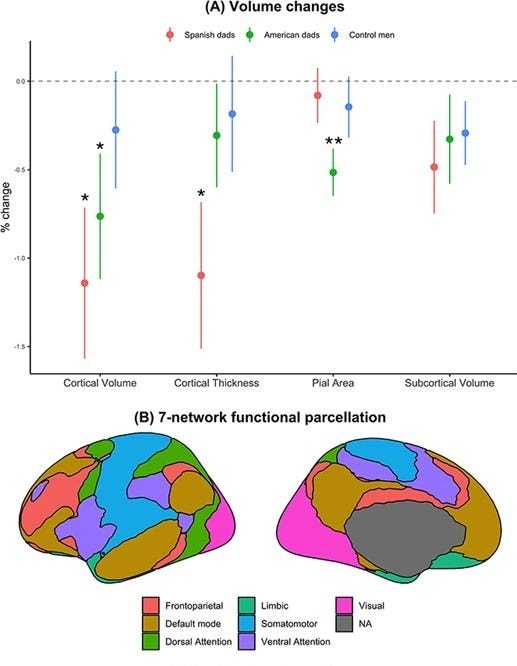
Saxbe then reports on her graduate student’s direct comparison of the maternal and paternal brain changes, finding some sex specificity. The maternal volume losses were more widespread across subcortical and cortical regions, while the paternal losses were mostly cortical. She argues this may be related to the facultative role of fatherhood, where fathers “choices” play a larger role in the changes the brain undergoes, and she claims that the magnitude of the brain volume changes in dads is partially explained by the nature of their involvement.
At the close the chapter Saxbe rightly caveats the conclusions of these imaging studies, highlighting that they’re underpowered. Elsewhere, she’s acknowledged that other imaging studies of the brains of dads have reported somewhat contradictory findings, including volume increases.7 Personally, I put little stock in small studies using brain imaging given the limitations of the technology and associated methods, however, I think we should have a strong prior that parenthood is likely to have meaningful effects on our neurobiology and that these are changes facilitate important dimensions of the parental contribution and burgeoning relationship.
Test-22
In The WEIRDest People in the World, Joseph Henrich helped popularize research, namely research by Lee Gettler performed on men in the Philippines, that shows that fatherhood significantly lower testosterone levels in men. The average drop is 25%! Joe Rogan listeners and bodybuilders may find this news shocking and disturbing, but a clearer understanding of the complex relationship between hormones and behavior is clarifying. In fact, men from the same study with higher testosterone when single were more likely to obtain a female partner and become fathers. This implies a tradeoff between life strategies and testosterone levels, where high testosterone is advantageous during mate competition at the cost of pair-bonding. Contrastingly, lower testosterone levels enables a man to stay simpatico with his partner and provide more attentive care to his offspring (and to live a longer healthier life!).
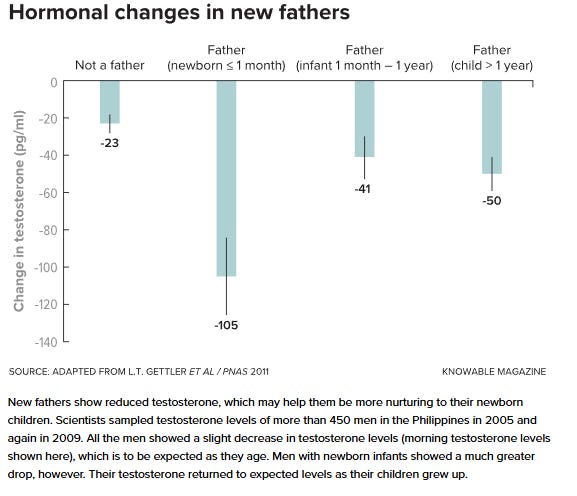
Saxbe echoes this narrative but takes it in a different direction than Henrich, who attaches civilization-level significance to the testosterone suppression effect of marriage and fatherhood. For Henrich, the testosterone control is a cultural adaptation that yokes and leverages our biology, but for Saxbe it is a bit of a conundrum. First, she highlights that despite the pros of low testosterone, there are psychological costs to the decline for new fathers, almost mirroring postpartum depression in some instances, but she also is uncomfortable with the tension among the social costs of high testosterone and its contribution to male desirability. Men are in a bind, a Test-22. Gender egalitarians tend to look askance at or vehemently condemn high T associated behaviors: aggression, lasciviousness, boorishness, competitiveness, etc. These behaviors are cast as toxic and dangerous yet they also may increase the mate value of these men (think Clavicular’s Jestermaxxing). On the other hand, eagerly embracing the testosterone penalty of marriage and fatherhood may put a man’s desirability as a long-term partner at risk, raising the nightmares of divorce, emasculation, cuckoldry, etc.
No Trad-wifey Girls in a Heterofalalist World
At the halfway point, Saxbe has a brief interlude where she pivots from the biological changes of fatherhood to the psychological and social challenges that modern parenthood creates romantically for couples. Despite Saxbe’s equanimity, the book’s discussion of rhetorical touchstones like “invisible labor” and “cognitive burden” are inexorably shaped by the broader cultural context and history of feminist rhetoric, which can’t help but implicitly indict and ridicule laggard men and their malingering or weaponized incompetence. Saxbe isn’t really that guilty of this, even drawing attention too some of the ways in which the behavior of women excludes men from contributing, but there is nonetheless the implicit concern about lazy or incompetent men in the home. Further, the discussion cannot transcend the rhetorical environment that’s likely familiar to the readers of a book like this where the salient tone that percolates through, intentionally or not, when such concepts are raised reveals a palpable amount of resentment towards men for essentially not thinking and acting like women in relational contexts and this feeling is often legitimized rather than questioned. Men have their shortcomings, of course, but we’ve culturally tolerated, entertained, or tacitly endorsed too much male bashing, and it hasn’t forged the men we’ve been searching for, meanwhile this sort of rhetoric has progressively soured from hostility to resignation; the feminist penchant for neologisms has captured this trajectory, devolving from “manspreading” and “mansplaining” to “mankeeping” and “heteropessimism.”
Personally, I find life or relationship advice masquerading as an amalgam of science and therapy off-putting. Again, I don’t think Dad Brain should be understood as this, but it’s just that there are rhetorical parallels in the book to this pervasive tendency. And even if the research and vogue therapeutic modalities on such thorny life questions turns out to be all correct, I’d see myself as some exception, the dipole of a pick-me girl. I’ve yet to find such framings useful and also never really considered the issues as being important enough to merit what can be characterized as medical-grade attention. It’s mundane. It’s the main stuff of life. It is going to messy, frustrating, and uncomfortable. Plus, the prescriptions that do surface tend to be too narrow or too broad, and rarely, does the takeaway message seem to be that it’s simply okay to accept things as imperfect. Soldier on. But I guess, this is stereotypically masculine life advice…

Dads Parenting Differently
The second half of the book examines the modern practice of fatherhood and some of the related sociopolitical context. Relative to the first portion of the book, it contains more normative claims (implicit and explicit), where Saxbe stakes out a progressive or left-liberal view of the place of fatherhood in society (e.g. “Fatherhood as a Public Good”). This portion is also a bit of a grab bag, churning through a wide variety of topics quickly like adoptive fathers, nonresidential fathers, stepfathers, fatherlessness, public policy (e.g. paternity leave), and cultural scripts (e.g. the bumbling dad). I fear Saxbe uses this part of the book to cover every base and be a bit politic about sensitive subjects. This may distract readers from the central normative message that I think this portion of the book actually delivers: children benefit from and thus deserve good dads.
Unlike many of who share her politics, Saxbe openly acknowledges that fathers “aren’t just male mothers” that they have “distinct styles of parenting.” This may seem obvious to readers, but it’s remarkable insofar as it broadly accepts typically right-of-center claims about the social value of the traditional family unit from a left-of-center perspective.8 If fathers are doing something special for children and it helps children, then the optimal childrearing environment obviously is a home in which fathers are present and engaged (along with the mothers of course). There is not really a way to engineer oneself out of this conclusion. Unsurprising though, Saxbe does try to wriggle away from it. She forwards an inclusive conception of the social role of fathers and parries the traditional view with a more capacious understanding of childcare, the alloparenting model aka the “it takes a village” concept, which is consider more ancestral for humans by anthropologists. What isn’t considered is whether a more alloparental model would actually crowd out the very engaged role that married fathers tend to play today. Is this what we want? Further, Saxbe doesn’t really engage with the kind of social change that would be necessary to move back towards more of such a model of childrearing.9
Does the data really show that fathers do some special and essential for kids? Saxbe doesn’t rigorously explore this question, but she does cite research on the topic, starting with findings that go back four decades now and have yet to be meaningfully disputed. This work observed that the dynamic between infants and fathers is more playful and tactile than between mothers and infants. Since then, research has continued to find that father-led “active physical play” has consistently had positive effects on child development, fostering important life skills. She also hints at a “tots for mom, teens for dad” model of parenting where after the critical mom-infant/young child period elapses dads can takeover an engaged mentorship role. This is all intuitive to those who have been parenting awhile, but Saxbe does start to tease out some of the ways common human tendencies and the social realities downstream of them shape the options and opportunities before parents.
Can We Get More Dads By Making Parenting Prestigious?
There is a popular feminist argument that claims that feminized labor, especially domestic work or childcare, is artificially under-valued by our society. This is extended to the idea that the proportion of men in a field is a driver of that field’s prestige and thus its level of compensation. Saxbe believes in some version of this argument and believes that if there was an influx of men into these forms of care work traditionally thought of as feminine then there would be a transformation in the social prestige attached to it. Subsequently, many new avenues for men to achieve status would open up, increasing their marriageability and thus their likelihood of becoming a father or a father to multiple children. She believes in this argument enough to conclude the book with it.
As is probably already clear, I’m quite skeptical of this narrative. I have strong theoretical (related to evolved biological sex differences) and empirical objections. However, the empirical problems alone should be enough to foreclose entertaining it further.10 Almost all of the research that is cited as evidence for this argument lacks rigor, specifically there is a lack of clean causal identification in the studies. Historically, these claims have been supported by cross-sectional data, which suffers from omitted variable bias and the prospect of reverse causality (i.e. Do women preferentially enter low-paying fields rather than their entry leading to wage declines?). Plus, when more rigorous designs have been attempted the alleged effect is either not observed, attenuates, or not causally mediated by the sex composition itself.
Despite my skepticism, I’m worry about the burden of work that many modern mothers face. It is understandable that many feel overworked and stressed out. If there was an easy way for fathers to substitute themselves and give moms a break, I’d be happy to entertain it. I don’t see such an option, especially one that wouldn’t have more costs than benefits. I think the main reasons the burdens differ between the sexes are biological sex differences influencing psychological tendencies. Egalitarian marriages are now the largest plurality of household arrangements and fathers are doing more domestic and care work than ever before, but the burden on women hasn’t let up. In fact, women has preferentially ratcheted up their investments. The reality is that men and women approach parental investment differently, and any mechanism to force women from continuing their intense personal investment in their children would be perverse or illiberal.11
Part of the reason that mothers have opted to invest so much is that there is a parenting arms race. Heavy investment in children is an (upper) middle class American norm that kicked off a generation or two before Millennials even aged into parenthood. So solving for the stress on mothers, requires solving a series of different prisoner’s dilemmas. And even if we all culturally agreed on a parental détente, it would not eliminate the kin-based incentives inherently built into the proposition of parenting. Parental investment is a kind of luxury that many luxuriate in despite how taxing it is. Some people like running marathons after all! Is it ridiculous to believe that women are simply more likely to draw greater meaning and enjoyment from parenting, especially very young children, compared to men? Such a reality seems pretty evolutionarily convenient.
Despite my critique, I found reading Dad Brain a worthy use of my limited time as a parent to three children myself, and I’m happy to recommend it to any curious reader. I care about being a part of the public discourse about fatherhood because I hope to model it as a positive and worthwhile experience to others and to help graduate more Americans into family life. It is a tough problem, and I don’t think any of us have an easy fix. The energizing part is that people like professor Saxbe, who have a different perspective than me, can still largely agree on this vision. It is a basis for continuing to build a culture that is broadly pro-family.
This is covered in detail in an article called How American Dads Became the Parents Their Fathers Never Were by Derek Thompson & Aziz Sunderji.
Data show young men today still express a strong interest in becoming dads. Covered by The Gray Area Podcast in February of this year.
I’m not even particularly persuaded by arguments about the costs of inequality and the need for more egalitarian outcomes in society, but when we shut the door for millions on what many call the “biological imperative” this may be a greater risk than some people have astronomically more wealth than others, especially when it cashes out as dramatic declines in the population. To be honest, I mean this line as a challenge to professed egalitarian who are eager to appropriate earned income or financial wealth but think it abhorrent to analyze sex, marriage, and fatherhood with the same crude Marxism.
This is before we consider how fatherhood may vary cross-culturally.
Here, I want to disclose some of my strong priors: 1) Biological sex differences are real and socially meaningful. 2) Many scientists, especially those closers to the social sciences or politically relevant research topics, tend to be eager to play down biological sex differences in ways that misunderstand how “culture” or environments are as likely to abet as to hinder innate sex differences. 3) The maintenance of any cultural practice that attempts to work against the social gradient created by biological sex differences will typically have inherently higher costs than an aligned or amplifying cultural practice. 4) Culture and environments do modify sex differences, sometimes significantly attenuating them, though these rarely if ever reverse the direction of the average difference. Paradoxically, it is often harsher conditions or seemingly more conservative practices that often attenuate these sex differences.
Chapter 7 of Saxbe’s book recapitulates much of the same endocrinological research in human parents that Hrdy draws on, including research from Ruth Feldman’s lab.
Also, can see PMID: 36603042 and PMID: 41429437 for additional research on the same question that make for a less straightforward scientific narrative.
Saxbe selectively resists a biological account of the parenting differences associated with fatherhood, which appears born of her skepticism about the conclusion that the transitive logic of that reality given the assumed/observed positive impact of dads compels.
Not to say that she isn’t aware of these factors. They just don’t really make it into the book.
There is a similar story for the gender wage gap claims, though it has been so empirically refuted that it has receded.
As an illustrative example, compare Saxbe’s treatment of the care work of parenting to Bryan Caplan’s in Selfish Reasons to Have More Kids. See my review of Caplan’s book here.
If “Egalitarian marriages are now the largest plurality of household arrangements and fathers are doing more domestic and care work than ever before, but the burden on women hasn’t let up.” I don’t understand the worry you have for mothers being “stressed out” or is that just the lower reserve millennials moms?