

While reading and reviewing Madeleine Beekman’s The Origin of Language: How We Learned to Speak and Why, I came across a provocative claim about phoneme diversity in modern human populations and what this can tell us about the origin of language.1 The overall claim has a few components, which I will walk through, but the general gist is that the fundamental unit of language, the phoneme, behaves similarly to the fundamental unit of biological evolution and heredity, the gene. Just like genes, phonemes can allegedly change with respect to prior forms, be transmitted from one generation to the next, and be selected for on the basis of some environmental condition. The only differences concern the mechanisms of transmission and mutability, which we can just sort out by modeling different assumptions about these parameters. Genes flow vertically through generations via sexual reproduction, while phonemes travel vertically through generations via the social environment, especially the early social environment. Genes change quasi-randomly at a predictable and slow rate, while it is less clear how predictably and how fast phonemes can change.2
Nevertheless, the similarities between genes and phonemes are so tantalizing to those who study evolution, they beg a comparison. In chapter 7 of her book, Beekman confidently asserts that genes and phonemes show the proverbial “Out-of-Africa” pattern:
Modern African languages are the most phonemically diverse. The smallest phonemic language diversity is found in South America and Oceania—some of the most recent areas to be colonized by our species. !Xun, a language spoken in southern Africa, has 141 phonemes. Rotokas, a language spoken in New Guinea, and Pirahã, a Sotuh American language, both have only 11 phonemes.
The assertion was striking to me as I was also aware of similar claims about cultural variation.3 Despite their plausibility and Beekman’s confidence, I felt compelled to follow-up on the claim, especially because there were not any immediate citations or footnotes in the book. Based on some Googling around and some assistance from the latest generative AI tools, I was able to identity the probable paper that served as the basis for Beekman’s claim, Q.D. Atkinson’s 2011 report in Science Magazine; the conclusion from the author of the report is quite clear:
[T]he number of phonemes used in a global sample of 504 languages is also clinal and fits a serial founder–effect model of expansion from an inferred origin in Africa. This result, which is not explained by more recent demographic history, local language diversity, or statistical non-independence within language families, points to parallel mechanisms shaping genetic and linguistic diversity and supports an African origin of modern human languages.
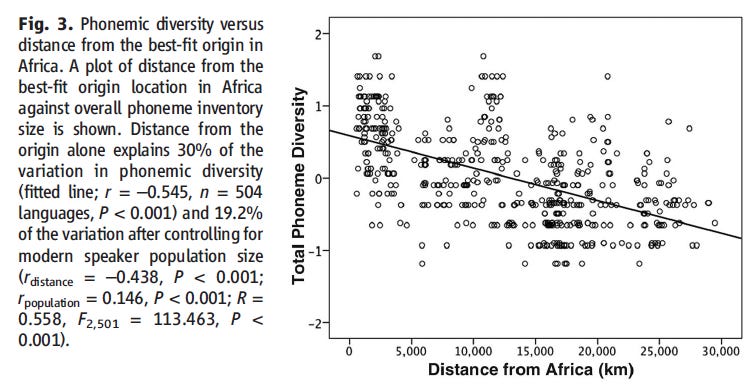
It does appear Beekman is correct in broad strokes. The diversity of sound units in a language appears to bear an important imprint from the rapid global dispersal of anatomically modern humans from Africa between 70-50 kya.4 However, there is a substantial difference in the magnitude of variation explained by the model between genes and phonemes. The Out-of-Africa (OOA) model accounts for 80-85% of the variation in neutral genetic markers in the genome but only 19%-30% of the variation phonemes in global languages.5 Why the difference?6
The Atkinson paper doesn’t immediately have a great explanation for why the serial founder model of the OOA dispersal is better for genes than phonemes. However, the author gestures at the similar levels of variation OOA explains in mitochondrial DNA (mtDNA) and some phenotypic measures.7 Due to the maternal transmission of mtDNA, this observation is intriguing given Beekman’s hypothesis that language evolved due to the intense pair-bonding and caretaking demands of parenthood, though it also suggests a significant modification to Beekman’s model: maybe it is just mothers and children creating the selection pressure and driving the social learning involved in language rather than the broader social group.
Although I’m not entirely sure how Beekman would respond to this modification of her theory, I do think she would be disinclined to embrace it. She makes some less than laudatory claims about the cultural effects of the nuclear family with respect to the sophistication of language and socialization:
Cultural evolution brought us the nuclear family. Most of the time, we see cultural evolution as a positive force, trumping biological evolution in the speed with which it can effect positive change. But the emergence of the nuclear family was far from an unalloyed good, and it has pushed us too far from our biological roots. Thanks to language, our species could raised more children by recruiting helpers. As modern parents become more isolated from their extend family, raising the next generation becomes an even bigger challenge. Many children in the Western world grow up without grandparents, either because they no longer live nearby or they died owing to the later age at which many women now become mothers. I had a fortunate childhood. Not only did I have my grandparents, but I also had my great-grandparents until I was well into my teens. They were of great help to my parents, emotionally and, when the need arose, financially. For me, they were repositories of knowledge, my emotional soundboards. They spoiled me, too, knowing well that my parents would have to deal with the consequences. Grandparents and other elders have played such roles throughout most of human history and prehistory.
Now, I personally don’t see an enormous distinction between the ideal of the Western nuclear family and significant alloparental contributions from grandparents or even great-grandparents. This looks like a distinction of degree rather than kind. It’s a narrow slice of the same genetic lineage, and this wouldn’t implicate the broader social processes that Beekman gestures to as important to the need for complex language in other parts of her book (i.e. a communal model of caring for the young).
I think Beekman’s concern with respect to language and general social sophistication and the historical increase in Western atomization, the partitioning into what Edmund Burke referred to as “little platoons,” is misplaced, emerging from more primitive Rousseauan moral instincts that don’t map constructively onto today’s W.E.I.RD. societies. Some of her concerns may also be informed by the same phoneme research, which identifies population size as an important determinant. However, Beekman presents no evidence that atomization in Western societies is affecting phoneme diversity. Heck, Beekman doesn’t bother to show that phoneme diversity has any relationship with the content or sophistication of what can be communicated. It is just implicitly assumed that more sound units equals greater and more refined communication. Is this actually true?
What is the Relationship between Phonemes and Linguistic Complexity?
It is often argued that the sophistication of human language is so great because of a design feature called “duality of patterning” or “double articulation,” which is just the idea that arbitrary, meaningless yet distinct sounds (phonemes) can be combined into meaningful units (words), which can be further arranged syntactically (sentences). Extending this further, it follows that the complexity of a language must arise due to some interaction among these three levels of variation. What’s the verdict on this?
Unsurprisingly, it is hotly debated. It is quite unclear if the phoneme inventories really have any relationship at all with linguistic complexity, especially in terms of what is actually being communicated rather than just having a lot of ways to potentially communicate the same things. There is perhaps some relationship between phoneme variation and syllabic complexity, but even here there are conflicting results. Here’s a quick summary of this debate excerpted from 2021 analysis:
Phoneme inventory size and its relationships with linguistic and nonlinguistic variables remains a matter of debate. The literature about cross-linguistic associations between phoneme inventory size and other linguistic components starts with a paper by Nettle (1995) who reports for a sample of 10 languages an inverse relationship between phoneme inventory size and the average length of a word. Nettle (1998) could repeat this finding for 12 West-African languages and Wichmann et al. (2011) for a sample of more than 3,000 languages averaged over families and macro-areas. Moran and Blasi (2014) likewise replicated a negative correlation between number of segments and word length and demonstrated, moreover, that this inverse relationship shows particularly with the number of vowels. As to syllable complexity measured as number of phonemes Maddieson (2006), Fenk-Oczlon and Fenk (2008) and Easterday (2019) report a positive correlation between inventory size and syllable complexity. Concerning the relationship between phoneme inventory size and the nonlinguistic variable population size, the finding of Hay and Bauer (2007) that languages with more speakers tend to have larger phoneme inventories attracted a lot of interest and has been the subject of extensive debate. Atkinson (2011) and Wichmann et al. (2011) could replicate Hay and Bauer's finding, but Donohue and Nichols (2011) and Moran et al. (2012) could not find such a correlation.
As already hinted above, the whole question of phoneme variation, while engrossing, may be entirely divorced from what can actually be communicated with language. There may be some lower bound of required phonemes needed for a full slate of human communication, but it would likely be irrelevant to actually understanding the linguistic complexity of present day languages or those of human prehistory.8
For those familiar with Chomsky’s work on universal grammar, they are likely jumping up and down while reading this, frantically yelling “RECURSION.” They’re right to draw attention to this design feature in human grammar — something that can refer to itself or embed an existing relationship can do so ad infinitum. Language’s recursive nature makes it trivial to generate an infinite number of distinct sentences from even just a small number of words.9

Now, recursion itself doesn’t necessarily mean all ideas can easily be communicated from a limited set of phonemes, but it also seems trivial to see the route to linguistic innovation without even needing more phonemes given the aforementioned duality of patterning. As anyone with young children knows, they’re wont to combine the sounds they already know into all kinds of nonsense words or even invent private neologisms. Thus, returning to the global pattern of average phone diversity, the more pressing question concerns the actual conditions that increased phoneme diversity in the first place? And why did the phoneme diversity expand so much seemingly just prior to modern human dispersal from Africa? Were there any actual consequences when phoneme inventories reduced during the dispersal? Unfortunately, it is unlikely that we’ll ever be able to confidently answer any of these questions.
Do Phonemes Actually Behave Like Genes?
Despite some of the similarities between genes and phonemes, I think the short answer is no. The differentiating factors are how and why phonemes and genes change over time. There are biochemical and other biological factors that govern the stochastic process of genomic variation, which also accumulates over time. While it’s a bit unclear where phoneme actually emerge from, they change because of social, demographic, and technological processes (contact, prestige, isolation, literacy, etc) rather than random processes. Moreover, these social processes can be non-linear, reversible and rapid. While not impossible in biological evolution, the fidelity and mutability of the phoneme is much lower over generational time than the information content in genomes. These fundamental differences mean that the “molecular clock” model is reliable for genes and unreliable for phonemes.10
There is a nice empirical demonstration of the divergence of genes and phonemes in a 2015 study published in PNAS. It partially recapitulate, though questions, the findings from Atkinson’s 2011 papers, but shows that genetic and phonemic diversity do not universally track:
Global genetic and phonemic patterns were not universally concordant: the most genetically polymorphic populations [top fifth percentile for number of microsatellite alleles observed] are all in Africa, whereas the largest phoneme inventories in the Ruhlen database (top 5% of 2,082 languages, corresponding to at least 43 phonemes) (SI Appendix, Table S4) were globally distributed, predominantly in Africa (41 languages), Asia (32 languages), and North America (18 languages).
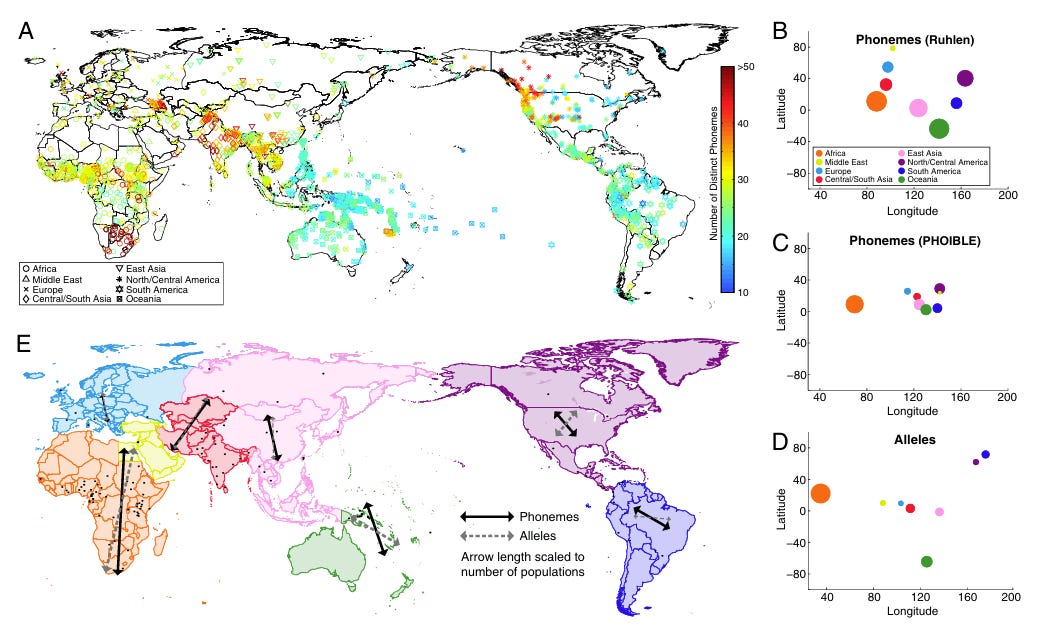
Further, the paper shows that in contrasts to the genetic repertoires of isolated population, the phonemic inventories of isolated populations tend to vary substantially:
[A]lthough geographically isolated populations lose genetic diversity via genetic drift, phonemes are not subject to drift in the same way: within a given geographic radius, languages that are relatively isolated exhibit more variance in number of phonemes than languages with many neighbors.
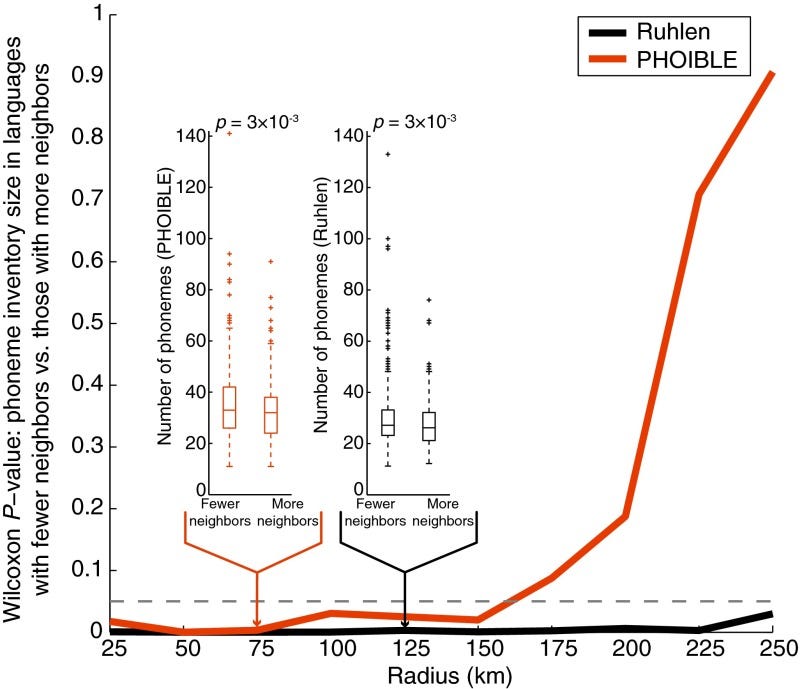
The authors of the 2015 paper assert their findings contradict the serial founder OOA model, suggesting some other mechanism must account for the low resolution trend in global phonemic inventories. However, these studies appear to be very sensitive to which languages are getting included in the analyses and other methodological differences. The conflicting data and models underscore the fact that map between genes and phenotypes, especially higher order phenotypes, is non-linear. The use of crude measures like assessing the total amount of average variation and its regional patterns doesn’t necessarily really tell us much unless we have an existing, established genotype-phenotype map.11
After diving into this literature thanks to an somewhat offhanded claim from Beekman, I’m left disappointed. Borrowing assumptions and methods from population genetics to study the prehistory of language is fraught. It would be lovely if we could entirely rely on these genetic models to pinpoint when language originated, how it dispersed, and how it changed over time. However, I think we should be wary of this. Nonetheless, my prior remains that human language did emerge in Africa prior to the OOA dispersal of modern humans, but unlike Beekman, I also think that archaic humans already outside of Africa’s border also possessed human language, though it was unlikely to be complex. Further, I think following the regional patterns of phonemic variation is misleading and is unlikely to tell us a great deal about the linguistic and cultural sophistication of human populations in prehistory. It may be more reliable to use the archaeological record, though this has other limitations. The best measure may just be using estimates of population sizes (to whatever limited extent we can accurately predict these) at certain time and places as a proxy for cultural complexity. Regardless of the challenges, I hope to see more interesting and daring work on questions about our deep history.
See Additional Commentary from Me on Phonemes and Genes:
A phoneme refers to a basic unit of speech, a phonetic unit, which is the simplest consistent sound that can be differentiated from each other. Phonemes are present in all spoken languages and have equivalent in gesture-based languages. All spoken languages have consonant and vowel phonemes. For example, the phoneme /k/ is found in words like cat, cork, skit, and scam.
In some way, phonemes themselves must be downstream of genes and to a lesser extent constrained by physics. The biology of the soft tissues in the throat is of course coded for by genes. They are shaped by evolution. The possibility space of evolution is constrained by physical laws.
See Hélios Delbrassine and colleagues’ pre-print (https://www.biorxiv.org/content/10.1101/2025.01.24.634692v1) or Oded Galor and colleagues’ “Roots of Cultural Diversity” paper (https://papers.ssrn.com/sol3/papers.cfm?abstract_id=5054239)
The same analysis also demonstrates that the size of a modern population of speakers of a certain language is also an important determinant of phoneme diversity. This independent variable also pulls this effect doesn’t account for all the regional variation in languages across the globe. The author speculate as to other possible determinants, including local language diversity, population density, and language area.
Interestingly, the amount of phonemic variance explain is similar to that other phenotypic pattern (various cranial metric) and is similar to mtDNA variance explained too. See PMID: 17637668 & PMID:19586946 for these data.
Another complexity here is that we can produce distinct model of OOA that still account for the same amount of clinal variation in phonemes: serial founder effects or successive bottlenecks. Arguably, the former is more parsimonious and is probably a better model of human genetic diversity.
Atkinson’s claims are based on estimates performed in the late 2000s, and the current estimates may be different.
For modern day phonemic diversity the question seems almost ridiculous given the relative stability yet constant exchange among world languages enabled by modern communication technologies. Additionally, the relationship between phoneme inventory and civilizational or even evolutionary success appears to be negligible.
Of course, the very politically correct belief is that no one human language is more sophisticated or complex than another. Linguists like John McWhorter reject this notion as silly, pointing out the relative simplicity of new creole language. However, it is true that there is not a methodological consensus on how linguistic complexity can be measured.
Although the pace of molecular events (mutations) differs across species (correlating with generational time), genes can be accurately modeled as a “molecular clock” (~1e-8 substitutions per nucleotide per generation in humans), and this can be leveraged to glean crucial insights into evolution and phylogeny.
It may be a hopeless venture to build this given that we can’t actually phenotype ancient populations. See my Substack Note.
The effect of recent agricultural expansions (Indo-European. East Asian and bantu) have surely erased much of the linguistic diversity of the previous forager populations over much of the world.
I just stumbled upon this essay while looking for something else (as these things go) and of course had to read it when I saw my name. I felt that I just had to make a comment regarding the association between phoneme diversity and language complexity. I did not use the phoneme study to claim anything about language diversity now or in the past. I just thought that the phonemes study was a nice way of estimating how old language (eg the ability to communicate complex ides) is.
I am sorry if it was hard to find my source. Normally I write scientific papers with references, but a popular book is structured differently.
Thank you for reviewing my book!